
Opening a Hong Kong limited company: the government is fast, the bank is slow
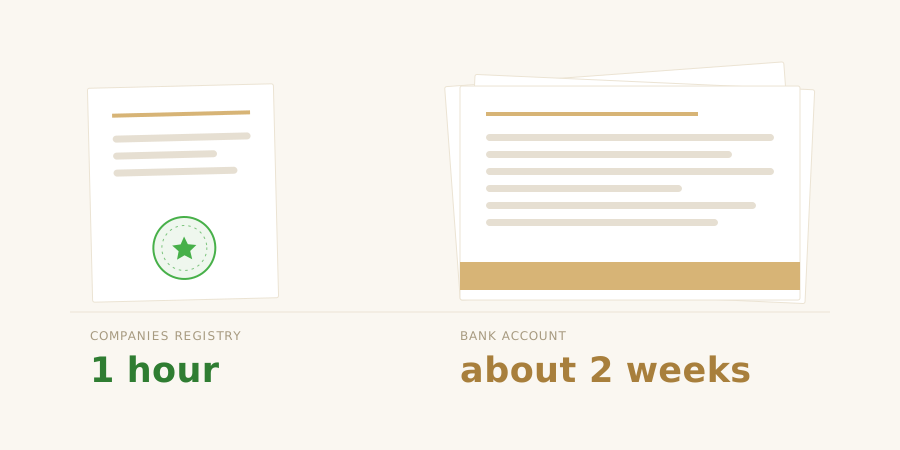
Opening a limited company runs on two clocks, and most people only see the first one.
The first is the government's: the Companies Registry promises to complete registration within 1 hour of electronic filing, and did so in 99.4% of cases in 2025; paper filings take 4 working days. The second is the bank's: the Hong Kong Monetary Authority says that once all required information and documents are in, opening a company account generally takes about 2 weeks. Government fees are fixed at $4,070 (incorporation fee $1,720, business registration fee $2,350), and nobody can reduce them.
Trust or Company Service Provider licence TC007926 · Updated September 2026
Most articles cover the first clock and then charge you for the second. This one covers both.
How long does it actually take to open a limited company in Hong Kong?
The government part is fast. The Companies Registry’s service pledge is that an electronic incorporation application for a local company is registered within 1 hour, with a target of 90% of cases; in 2025 it actually achieved 99.4%. For paper filings the pledge is 4 working days, target 95%, and the 2025 figure was 98.3%.
But that is the registration time inside the government’s system, not the time until you can start doing business. It does not include preparing your documents, verifying identities, or opening a bank account.
The real bottleneck is the bank. In a written reply to the Legislative Council on 18 June 2025, the Hong Kong Monetary Authority said that once all required information and documents have been received, opening a company account can “generally be completed in about 2 weeks”, and some cases within 1 week. The HKMA also said it sees no need at this stage to set a fixed processing time limit.
So a realistic expectation looks like this:
| Step | Who handles it | Time |
|---|---|---|
| Company name search | Companies Registry | Instant, free |
| File incorporation form (NNC1) and articles | Companies Registry | Electronic 1 hour (pledge) / paper 4 working days |
| CI and BR issued | Companies Registry, Inland Revenue Department | Together with incorporation |
| Open a bank account | Bank | Generally about 2 weeks once documents are complete (HKMA) |
Our Hong Kong company registration service delivers the certificate in 7 working days from the day your documents are complete, or 1 working day on the express plan. We can handle the bank part for you, but whether and when an account is approved is the bank’s decision.
How much does a limited company cost, and which part goes to the government?
Separate the two amounts first. One goes to the government: fixed, public, and nobody can reduce it. The other is the service fee, which is the only part worth comparing.
| Item | Collected by | Amount |
|---|---|---|
| Incorporation fee (paper filing) | Companies Registry | $1,720 |
| Business Registration Certificate (1 year) | Inland Revenue Department | $2,350 |
| Government fees subtotal | — | $4,070 |
| Business Registration Certificate (3 years) | Inland Revenue Department | $6,170 |
Our fee starts from $4,690, and the $4,070 of government fees above is already included. When you compare quotes, take the government’s $4,070 out first, then compare what is left; that is where the real difference lies.
Why did the business registration fee go from $2,200 back to $2,350?
Because a levy came back.
The Business Registration Certificate fee has two parts: a registration fee of $2,200 plus a Protection of Wages on Insolvency Fund levy of $150. The government waived the $150 levy for two years from 1 April 2024 and resumed collecting it from 1 April 2026. The 2026-27 Budget announced no new business registration fee concession.
So a 1-year certificate is now $2,350 and a 3-year certificate is $6,170. Any web page still showing $2,200 is quoting a waiver that has ended. Branch registration certificates are separate: $230 for 1 year.
Can one person open a limited company?
Yes. One person aged 18 or over may be the sole director and the sole shareholder at the same time. Hong Kong residents, mainland residents and overseas nationals can all do this; there is no requirement for a local director or local shareholder, and no need to visit Hong Kong in person.
There is, however, one rule that many people only discover the first time they set up a company: the sole director cannot also be the company secretary. Section 475(2) of the Companies Ordinance (Cap. 622) says so directly, and section 475(3) closes the side door: if a body corporate’s sole director is the very same person who is the company’s sole director, that body corporate cannot act as secretary either.
In other words, a one-person company must still appoint a Hong Kong resident, or a licensed firm, as its statutory company secretary. That is not an industry habit; it is a legal requirement.
Why is the bank account the slowest step?
Because the bank and the Companies Registry are doing two different jobs. The Registry checks that the documents are in the right form; the bank checks what the business is and where the money comes from.
Banks generally ask for: the Certificate of Incorporation, the Business Registration Certificate, the articles of association, the registers of directors and members, significant controller information, proof of identity and address for each director and shareholder, proof of business (contracts, invoices or a business plan), and an in-person or video meeting with the directors.
Two things worth knowing in advance:
- Digital banks may not help non-residents. Hong Kong currently has 8 licensed digital banks, 6 of which offer company accounts. But opening a company account online generally requires every director and shareholder to hold a Hong Kong identity card.
- Airwallex, Statrys and similar platforms are not banks. They are stored value facility or payment institutions, and balances held with them are not covered by the Deposit Protection Scheme. Bank deposits are protected up to $800,000 per depositor per bank (the limit rose from $500,000 on 1 October 2024).
The most common reason for not getting an account is not a problem with the company; it is a business that cannot be explained clearly. The nature of business on the Business Registration Certificate does not match what you actually do, the source of funds is not explained well enough, or the business documents are incomplete. Sorting out those three before you apply does more good than switching banks.
Once the company is open, what has to be filed in year one?
Six things. They belong to two different departments, each with its own deadline, and nobody sends you a single combined list.
| Obligation | Filed with | Deadline | Fee / penalty |
|---|---|---|---|
| Annual Return NAR1 | Companies Registry | Within 42 days after the anniversary of incorporation | On time $105; late $870 / $1,740 / $2,610 / $3,480 |
| Business Registration Certificate renewal | Inland Revenue Department | Before the certificate expires, within 1 month of the demand note | 1 year $2,350 |
| Significant Controllers Register (SCR) | Kept by the company at its registered office | Required from incorporation; update within 7 days of any change | Fine $25,000, plus $700 per day |
| First profits tax return | Inland Revenue Department | Generally issued about 18 months after incorporation; file within 3 months of issue | Late filing may lead to estimated assessment and penalties |
| MPF registration (if you have employees) | MPF trustee | Within 60 days of the employee starting | Maximum fine $350,000 and 3 years’ imprisonment |
| Employees’ compensation insurance (if you have employees) | Insurer | Before the first employee starts | Required by law |
Note that the NAR1 deadline runs from the anniversary of incorporation, not the financial year end. Those two dates are usually different, the late fee steps up with the number of days, and no waiver can be applied for.
If the company has not traded, does it skip the audit and the tax return?
No. This is the misunderstanding we correct most often.
Every limited company incorporated in Hong Kong must prepare financial statements each year and have them audited by a practising accountant; there is no turnover threshold. The reporting exemption in section 359 of the Companies Ordinance lets a qualifying small private company use simplified reporting standards (revenue and assets not exceeding $100,000,000, employees not exceeding 100, meeting two of the three tests), but what it exempts is the reporting format, not the audit itself.
The only companies that genuinely skip the audit are those declared dormant under the statutory procedure. The moment there is any significant accounting transaction, that status ends.
One more point: a company’s first financial year may run longer than 12 months, but not beyond 18 months from the date of incorporation. Keeping the books from day one is far cheaper than hunting for receipts 17 months later. Accounting and tax filing is something you do every year, not something you do when there is a problem.
The government fees, deadlines and penalties in this article are based on public information as at September 2026, from the Companies Registry, the Inland Revenue Department and the Hong Kong Monetary Authority. Government fees and filing arrangements may change; the relevant department’s announcements prevail. This article is general information and is not legal or tax advice.