
Can a virtual office be your registered address? Will the bank refuse an account because of it?
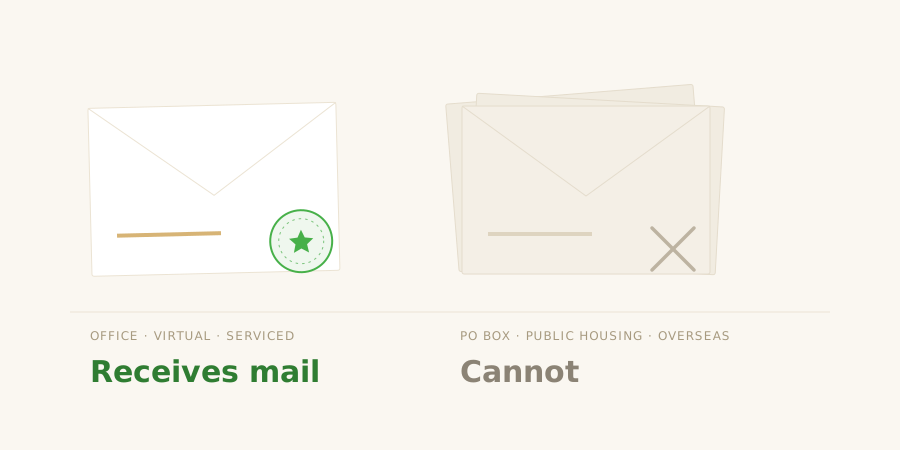
Yes. Using a virtual office as a company's registered address is legal.
What section 658 of the Companies Ordinance (Cap. 622) requires is an address in Hong Kong at which communications and notices can be received. A PO box, a made-up address or a public housing flat does not meet that test; a serviced office or a virtual office does. As for the claim that shared addresses are on a bank blacklist, we could not find any regulator, bank or news report behind it. The HKMA's 2017 circular on address verification actually relaxed the proof-of-address requirement. What you really need to check is whether the provider holds a licence.
Trust or Company Service Provider licence TC007926 · Updated September 2026
This question comes in two versions. One is a legal question, and the answer is clear. The other is a bank question, and the answer is that the story going round has no source.
What does the law require of a registered address?
One sentence.
Section 658 of the Companies Ordinance (Cap. 622) provides that a company must at all times have a registered office in Hong Kong to which all communications and notices may be addressed.
The key words are “may be addressed”. The law cares that documents can be delivered and that someone is there to receive them: letters from the Companies Registry and the Inland Revenue Department, court documents, all properly served during office hours. Registry staff may visit to verify. The company’s name, and the words showing it is a limited company, must also be clearly displayed at that address.
The law does not require you to work there. It does not require the address to be exclusively yours. And it does not prohibit sharing an address.
Having no registered address that meets the requirement, or moving without notifying, carries a maximum fine of $50,000 plus $1,000 per day.
Which addresses can be used, and which cannot?
| Type of address | Usable as registered address? | Shown on the public record? |
|---|---|---|
| Physical office in a commercial building | Yes | Yes |
| Virtual office (real Hong Kong address, receives mail, licensed provider) | Yes | Yes |
| Serviced office or rented desk | Yes | Yes |
| Your own home address | Yes | Yes (publicly searchable) |
| Public housing flat | No | — |
| PO box | No | — |
| Address outside Hong Kong | No | — |
Using your home address is what many people do in year one. It is legal, but the price is that your home address appears on the public record, where anyone can look it up. That is the most common reason people use a virtual office: not to look as if they have an office, but to keep their home address off the public record.
If I register with a virtual office, will the bank refuse the account because of the address?
This claim is widespread on Chinese-language websites: certain “shared addresses” are on a bank blacklist, and using one gets you rejected.
We went looking for the source. There is none.
No Hong Kong Monetary Authority circular has ever mentioned it. No licensed bank has publicly stated that it does not accept virtual office addresses. There is no Legislative Council reply and no independent news report. Everything we could find was the web pages of agents and secretarial firms themselves, and the wording is always “may” or “can easily trigger”.
The evidence that does exist points the other way. The HKMA’s circular of 11 October 2017 on address verification requirements removed the requirement for financial institutions to collect proof-of-address documents for anti-money-laundering purposes; institutions only need to record the customer’s registered address and principal place of business. That is a relaxation, not a tightening.
So our position is this: it is an industry rumour, not a rule. We will not use it to scare you into buying a “safe” address.
So what does the bank actually look at?
Whether the business makes sense.
When an account is delayed or refused, the real reasons are usually these three: the nature of business on the Business Registration Certificate does not match the actual business; the source of funds is not explained well enough; the business documents (contracts, invoices, business plan) are incomplete. The address is just one field on the form.
One small thing is worth lining up first: write the address the same way everywhere. A common back-and-forth in account-opening stories online is the same address written differently on the company documents, the Business Registration Certificate and the application form, for example 5/F in one place and Floor 5 in another, and the applicant is asked to fill everything in again. That is individual experience, not a published rule, but the cost is tiny: check it once before you submit.
Registered address, business address, correspondence address: what is the difference?
Three addresses, three purposes, three levels of publicity.
| Address | Purpose | Publicity |
|---|---|---|
| Registered office address | Receiving government and legal documents (section 658) | On the Companies Registry’s public record |
| Principal place of business | The business location on the Business Registration Certificate | On the business registration record |
| Director’s correspondence address | The director’s external contact address | Publicly searchable |
| Director’s usual residential address | Where the director actually lives | Not public |
Protection of directors’ home addresses came in three phases: from 23 August 2021 companies may use correspondence addresses in their own registers; from 24 October 2022 the public index of directors shows correspondence addresses and partial identification numbers instead of residential addresses and full numbers; and from 27 December 2023 data subjects may apply to have protected information in earlier documents removed from public inspection as well.
In other words, directors’ home addresses now have statutory protection; the company’s registered address does not. The registered address is public by design.
How do I confirm that a company may legally provide a registered address?
Check the licence. It takes one minute, and almost no article selling addresses tells you to do it.
Anyone who provides a registered address, business address or correspondence address as a business, or who acts as or arranges a company secretary, must hold a Trust or Company Service Provider (TCSP) licence under the Anti-Money Laundering and Counter-Terrorist Financing Ordinance (Cap. 615). Solicitors and accounting professionals have separate exemptions.
- The register: tcsp.cr.gov.hk, kept by the Companies Registry, free to search.
- Operating without a licence is a criminal offence, with a maximum fine of $100,000 and 6 months’ imprisonment, and the court may also disqualify the person from holding a licence.
- This is not a dead letter. On 30 October 2018 a company services firm pleaded guilty at Sha Tin Magistrates’ Courts to operating without a licence, was fined a total of $50,000 and was disqualified from holding a licence for 6 months.
- As at the end of 2025 there were 7,220 licensees in Hong Kong.
Surplus’s licence number is TC007926, and you can check it right now. The same register lets you check every other provider you are comparing. That is more useful than comparing monthly fees.
What do I have to do when I change the address?
Two departments, two deadlines.
- Notify the Companies Registry: form NR1, within 15 days of the change, no government fee.
- Notify the Business Registration Office of the Inland Revenue Department: form IRC3111A, within 1 month.
Changing provider works the same way: you do not need your current provider’s consent to change your company secretary or registered address. It is a board resolution plus one form. The outgoing provider should hand back the statutory registers, the company chop, the Certificate of Incorporation and the Business Registration Certificate.
The address itself can be in Lai Chi Kok, Kwun Tong, Central or Fo Tan. We receive your mail and notify you the moment it arrives.
The statutory provisions, penalties and deadlines in this article are based on public information as at September 2026, from the Companies Registry, the Inland Revenue Department and the Hong Kong Monetary Authority. The arrangements may change; the relevant department’s announcements prevail. This article is general information and is not legal advice.