
Closing a Hong Kong business: deregistration, winding up and striking off explained
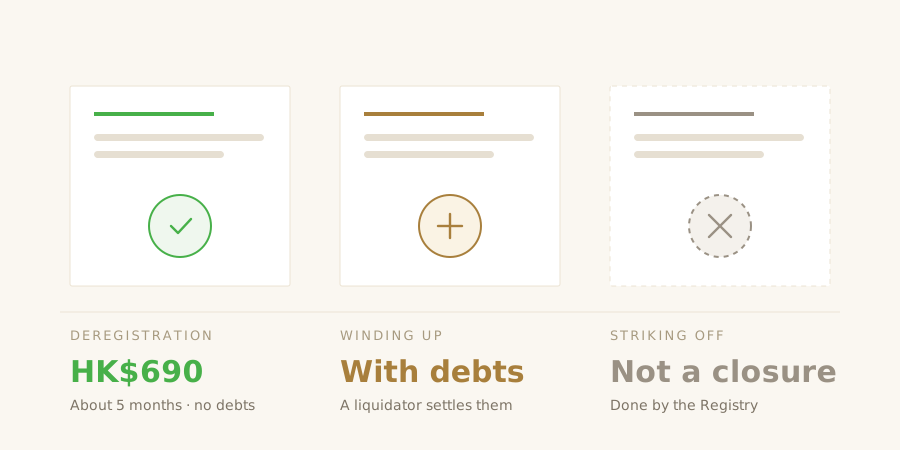
Deregistration (撤銷註冊), winding up (清盤) and striking off (除名) are three different ways a Hong Kong company comes to an end.
A limited company that has stopped trading and has no debts is usually deregistered: first get a notice of no objection from the Inland Revenue Department, then file form NDR1 with the Companies Registry. Government fees total HK$690 and the Registry estimates about 5 months. A company with debts to settle, or that does not meet the conditions, must be wound up. A sole proprietorship or partnership is not a company: it closes by notifying the Business Registration Office within 1 month. Striking off is the Registry removing a defunct company, not a way to close your own.
Trust or Company Service Provider Licence TC007926 · Updated: November 2026
Stopping business does not make a company disappear. A limited company has to be deregistered or wound up; a sole proprietorship has to cancel its business registration. The three routes have different conditions and costs.
What do deregistration, winding up and striking off mean?
Three terms, three ways a company ends:
- Deregistration (撤銷註冊). The company applies itself. For companies that have stopped trading and have no debts.
- Winding up (清盤). A liquidator deals with the assets and debts, then the company is dissolved.
- Striking off (除名, also 剔除註冊). The Companies Registry removes a company it believes is no longer operating. It is not a way for you to close a company.
One more term often mixed up with these: cancelling a business registration (取消商業登記). That is how a sole proprietorship or partnership closes; it does not apply to limited companies.
Which route fits my business?
Two questions decide it: is it a limited company, and does it have debts?
| Situation | Route | Who handles it |
|---|---|---|
| Sole proprietorship or partnership, stopped trading | Cancel business registration | Business Registration Office (IRD) |
| Limited company, stopped trading, no debts, no Hong Kong property | Deregistration | IRD, then Companies Registry |
| Limited company with debts to settle or assets to distribute | Winding up | A liquidator, then court or Registry procedure |
| Limited company not operating and not replying to the Registry | May be struck off (not your choice) | Companies Registry |
Most small limited companies that have stopped trading are deregistered.
What are the conditions for deregistering a limited company?
The conditions are in sections 749 to 751 of the Companies Ordinance (Cap. 622). Before applying, the company must meet all of them:
- All members agree to the deregistration.
- The company has never started business, or has not operated or carried on business in the 3 months before the application.
- It has no outstanding liabilities.
- It is not a party to any legal proceedings.
- Neither the company nor any applicable subsidiary holds immovable property in Hong Kong.
- It has a notice of no objection from the Inland Revenue Department.
Before issuing the notice, the IRD will expect the company to dispose of stock, property and securities, file all tax returns and pay all tax.
Steps, forms and fees for deregistration
| Step | Form | Government fee | Timing |
|---|---|---|---|
| 1. Apply for notice of no objection | IRD form IR1263 | HK$270 (non-refundable) | Usually 21 working days after a valid application and payment |
| 2. Apply for deregistration | Companies Registry form NDR1 + the notice | HK$420 (non-refundable) | Normally filed within 3 months of the notice |
| 3. Gazette and dissolution | Two Gazette notices by the Registry | — | 3-month objection period after the first notice |
| Total | HK$690 | Registry estimate about 5 months |
HK$690 is government fees only. Tax owed before closing, business registration fees still due, and any service fees are extra.
While the application is pending, the company still exists and must keep meeting its legal obligations. Business registration fees are in principle still payable; the IRD may defer them case by case, but this is not automatic, so do not stop paying on your own.
There is still money in the bank account. Can I deregister anyway?
You should not. Property the company still holds when it is dissolved becomes ownerless property and passes to the Government.
Before applying, deal with:
- the bank balance, and close the company account
- receivables
- vehicles, equipment and other assets
- trademarks registered in the company’s name
The legal conditions are no debts and no Hong Kong immovable property, not “every asset must be zero”. But whatever is left in the company’s name stops being yours once it is dissolved.
When does a company need to be wound up?
When it has debts to settle, assets to distribute formally, or does not meet the conditions for deregistration. Winding up is governed mainly by the Companies (Winding Up and Miscellaneous Provisions) Ordinance (Cap. 32), not Cap. 622.
There are three kinds:
| Type | When it applies | Timing |
|---|---|---|
| Members’ voluntary winding up | The company is solvent; directors make a certificate of solvency (NW1) that all debts can be paid within 12 months | No official overall time limit; the 12 months is the solvency test, not the completion period |
| Creditors’ voluntary winding up | The company cannot make a certificate of solvency | Varies widely with assets, tax and litigation |
| Compulsory winding up | The court orders it on statutory grounds such as inability to pay debts; a creditor, the company or a shareholder can petition | No standard completion period |
A compulsory winding-up petition has a court fee of HK$1,045, plus a HK$11,250 deposit to the Official Receiver’s Office. The deposit covers the Office’s fees and expenses; it is not the liquidator’s pay. Liquidator, lawyer and accountant fees are separate.
A company with debts cannot use deregistration to bypass its creditors.
What does it mean to be struck off by the Companies Registry?
If the Registry believes a company is not operating, it first writes to ask, then publishes a notice. 3 months after the notice, unless cause is shown, the company is struck off and is dissolved once that is published in the Gazette.
Striking off is not a shortcut. Assets left in a dissolved company pass to the Government. If the company was still operating when it was struck off, a former director or member can apply within 20 years of dissolution to restore it, paying a HK$2,700 government fee plus any outstanding annual returns.
How do sole proprietorships and partnerships close?
They are not limited companies, so there is no deregistration or winding up. Within 1 month of ceasing business, notify the Business Registration Office to cancel the registration:
- on form IRC 3113, or by letter giving the business registration number, business name, address, date of cessation, and a contact address and phone number after cessation;
- or through the designated GovHK online service.
Cancelling the registration does not cancel tax already owed. Prepare accounts from the last accounting date to the date of cessation, report the final profit or loss, and pay any tax. Sole proprietors use the individual tax return (BIR60); partnerships use BIR52. Keep business records for at least 7 years.
The three routes side by side
| Cancel business registration | Deregistration | Winding up | |
|---|---|---|---|
| For | Sole proprietorships, partnerships | Non-trading limited companies with no debts | Limited companies with debts or assets to distribute |
| Main forms | IRC 3113 or written notice | IR1263, then NDR1 | NW1, special resolution etc. (depends on type) |
| Government fees | No separate application fee listed; the business registration fee for the final year is still payable | HK$690 | Depends on type; compulsory: HK$1,045 + HK$11,250 deposit |
| Time | Notify within 1 month of ceasing | About 5 months | Case by case, no standard period |
Checklist before you close
- Confirm the business structure: sole proprietorship, partnership or limited company.
- Limited company: confirm no debts, no Hong Kong property, and all members agree.
- File every outstanding tax return and pay all tax.
- Deal with the bank balance, receivables and assets, then close the bank account.
- File any outstanding annual returns.
- Apply for the notice of no objection, then file NDR1 with the Registry within 3 months.
- Keep business records for at least 7 years after closing.
Closing a company is more than one form. Tax returns, audit, catching up on annual returns and closing the account: we can handle the whole thing in one go, followed up in the same WhatsApp group, with replies within 2 hours. See our accounting and tax and company secretary services, or contact us.
Laws, fees and timings in this article reflect public information as at November 2026, from the Companies Registry, the Inland Revenue Department, the Official Receiver’s Office, the Companies Ordinance (Cap. 622), the Companies (Winding Up and Miscellaneous Provisions) Ordinance (Cap. 32) and the Business Registration Ordinance (Cap. 310). Laws and fees may change; the relevant departments’ announcements prevail. This article is general information, not legal or tax advice.